







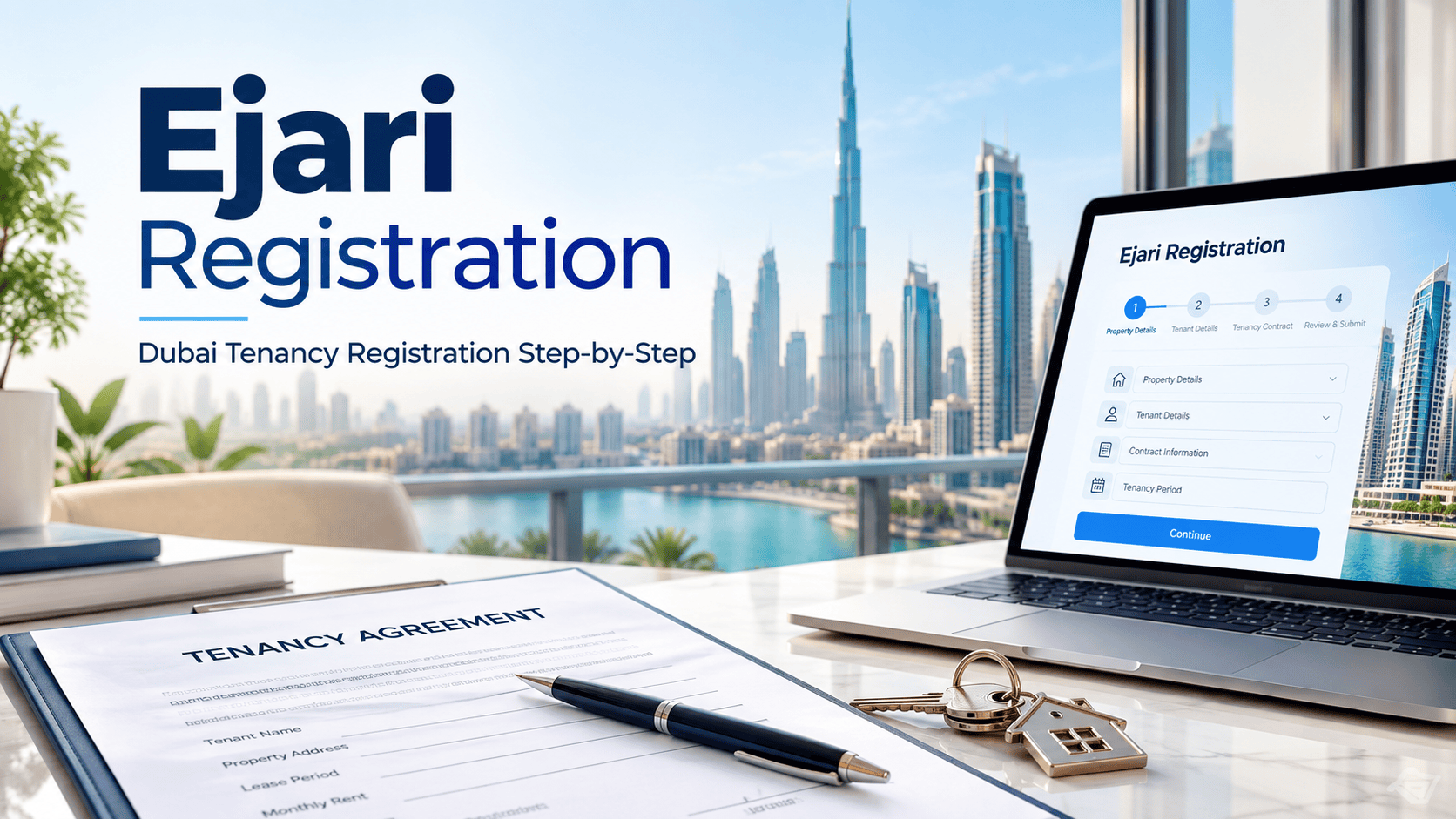
Ejari is Dubai’s official tenancy-registration system. Once you sign your lease, registering it on Ejari turns a private rental agreement into a record the Dubai Land Department (DLD), RERA, DEWA, and the Rental Dispute Centre can rely on.
This guide covers what Ejari is, who must register, current official fees, documents, online versus trustee-centre routes, and how registration unlocks DEWA move-in — without rehashing the full Renting in Dubai: Complete First-Timer’s Walkthrough.
Table of Contents
What Is Ejari in Dubai?
Ejari is the DLD / RERA electronic system that registers residential and commercial tenancy contracts in the Emirate of Dubai. Successful registration produces an e-Contract Registration Certificate (usually called an “Ejari certificate”).
Ejari sits on top of Dubai’s Unified Tenancy Contract — the standard lease format recognised by DLD. Signing that contract is not the same as registering it. Until the contract is logged in Ejari, government systems generally treat the tenancy as unregistered.
Why Does Ejari Registration Matter?
Without Ejari, tenants outside free-zone exemptions usually cannot activate DEWA, and both parties have a weaker position if a rental dispute reaches the Rental Dispute Centre.
Under Law No. (26) of 2007, as amended by Law No. (33) of 2008, lease contracts covered by the law — and any amendments — must be registered with RERA. The same law states that judicial authorities and government bodies may not consider a dispute or claim relating to a lease unless that contract is registered under the relevant rules.
In practice, Ejari registration creates an official record of landlord, tenant, property, rent, and term; feeds DEWA’s automated move-in for most mainland tenancies; strengthens your file at the Rental Dispute Centre; and is often requested wherever proof of tenancy is needed. For the wider legal picture after registration, see The Dubai Tenant’s Rights Bible.
Who Must Register Ejari: Landlord or Tenant?
Legally, the landlord is responsible for ensuring the tenancy is registered on Ejari. In practice, the tenant or the managing agent often submits the application and pays the official fee.
Clause 14 of DLD’s Unified Tenancy Contract has the landlord undertake to register the contract on Ejari and provide the required documents. Market practice frequently shifts the paperwork to the tenant or agency, sometimes via an addendum. Check your contract before you assume who will file and who will pay.
Who usually pays: There is no DLD rule that forces the tenant to pay. Customarily, the tenant covers the official registration fee unless the lease says otherwise. Agents sometimes add an extra “typing” or admin charge — that is not an official DLD fee. If it is not written in the contract, you can push back.
What Documents Do You Need for Ejari Registration?
Documents depend on the channel. Online via Dubai REST, DLD currently lists a copy of the Unified Tenancy Contract. At a Real Estate Services Trustee Centre, you need the original contract plus identity (and a power of attorney if someone applies on your behalf).
| Channel | Documents DLD lists |
|---|---|
| Dubai REST app / DLD website | Copy of the Unified Tenancy Contract (individuals and companies) |
| Real Estate Services Trustee Centre | Original Unified Tenancy Contract; Emirates ID of the applicant; official Power of Attorney if a representative applies (Dubai-issued POA: number may be enough; other-emirate POA: attach the document) |
Older blog checklists often demand title deeds, landlord passports, deposit receipts, and DEWA bills for every online filing. Stick to what DLD publishes for your channel, then add anything the app or trustee desk specifically requests. Keep your DEWA 9-digit premises number handy — it appears on the unit door and helps map the property correctly for utilities after registration.
If you pay rent by post-dated cheques, make sure the cheque schedule on the Unified Tenancy Contract matches reality before you upload. See Dubai Rental Cheques for how cheque schedules usually appear on Dubai leases.
How Much Does Ejari Registration Cost in Dubai?
As published on DLD’s Register / Renew Tenancy Contract service page (verified September 2026), online registration totals AED 177.75; a Real Estate Services Trustee Centre totals AED 220.
| Fee component | Dubai REST / DLD website | Trustee centre |
|---|---|---|
| Tenancy contract registration | AED 100 | AED 100 |
| Knowledge fee | AED 10 | AED 10 |
| Innovation fee | AED 10 | AED 10 |
| Service partner fee + VAT | AED 55 + AED 2.75 VAT | AED 95 + VAT |
| Total | AED 177.75 | AED 220 |
Payment methods DLD lists: credit card, cash (trustee centres), and Noqodi wallet (online). These figures are official DLD / service-partner fees, not agent mark-ups. Confirm the amount shown in Dubai REST or on the live DLD page before you pay — fees can change. Anything an agent charges above this total is a private service fee unless your contract already agreed to it.
How Do You Register Ejari Online (Dubai REST / DLD Website)?
Log in to Dubai REST or the DLD Ejari web service, enter the lease details, upload the Unified Tenancy Contract, pay the fees, wait for review, then download the e-Contract Registration Certificate from email or the app.
Order that matches DLD’s published steps:
- Sign the Unified Tenancy Contract with the landlord (or authorised representative).
- Open Dubai REST (or the DLD website Ejari service) and choose register / renew tenancy contract.
- Enter property and party details exactly as on the contract.
- Upload a clear copy of the Unified Tenancy Contract.
- Submit and pay the displayed fees (currently AED 177.75 online).
- If the tenant started the request, the landlord may need to approve it in the app before it completes.
- After DLD review, receive the e-Contract Registration Certificate by email or in-app download.
Mobile-route eligibility: DLD states that for registration through mobile applications, the tenant and landlord must be individuals and the owner’s data must be up to date. Company landlords, property managers, and some representative cases usually go through system access or a trustee centre instead.
When Should You Use a Real Estate Services Trustee Centre?
Use a trustee centre when the online route does not fit — for example when originals must be checked, a non-Dubai POA needs attaching, or the property/party type falls outside the app conditions.
DLD’s trustee-centre terms include: the property must not already be managed by a real estate company or by an owner who has Ejari system access; the applicant must be the tenant or a legal representative with a valid POA; and the landlord must be the owner or a legal representative with a valid POA. Published service time is 25 minutes, excluding waiting. Fee total: AED 220.
How Does Ejari Connect to DEWA Move-In?
For most mainland tenancies, DEWA treats Ejari issuance as the trigger for move-in. After the certificate is issued, DEWA usually creates the account automatically and emails or texts a payment link — you do not need a separate tenancy-contract upload if you have a valid Ejari number.
DEWA’s Activation of Electricity/Water (Move-in) page describes digital integration with RERA. Tenants typically complete Ejari, receive a DEWA welcome SMS/email with account number and deposit details, pay the refundable security deposit and activation charges, then get supply targeted within 15 working hours after payment.
If the welcome message never arrives (wrong email entered during Ejari), apply on the DEWA website or app and enter your Ejari number. Free-zone premises exempt from Ejari apply directly with DEWA using the tenancy contract.
Full utility steps: How to Transfer DEWA to a New Apartment.
What Happens If You Skip Ejari, and Why Applications Stall?
Skipping Ejari blocks the standard DEWA move-in path for most tenants and leaves you on thinner ice for official dispute resolution. Law 26 / 33 expects registration before authorities act on lease-related claims. If you are already in a deposit fight and still lack registration, fix Ejari first where possible — see Security Deposit Disputes.
Most delays are data problems, not mysterious refusals. Fix before you submit: names/Emirates ID that do not match the contract; wrong DEWA premises number; unsigned or non-unified scans; a previous tenancy still active on the unit; missing landlord approval on a tenant-initiated Dubai REST request; outdated owner data on the mobile route; or a company/managed-property case filed on the wrong channel.
If a property manager already has system access, ask them to register rather than forcing a trustee visit; DLD terms may reject.
How Do You Renew or Amend Ejari?
Renewal uses the same DLD “Register / Renew Tenancy Contract” service and the same fee schedule. Renew Ejari when you renew the lease — usually right after the new Unified Tenancy Contract is signed. Mid-term changes (rent, term, parties, or property details) should be reflected so DEWA and dispute records stay accurate. Confirm current cancellation fees on the live DLD page if you are ending early.
Ejari Registration Checklist
- Sign the Unified Tenancy Contract (and any lawful addendum)
- Confirm who files and who pays the official fee
- Choose channel: Dubai REST / DLD website (AED 177.75) or trustee centre (AED 220)
- Gather the documents DLD lists for that channel
- Submit → pay → landlord approval if required → download the e-Contract Registration Certificate
- Watch for the DEWA welcome message and pay deposit/activation charges
- Save the certificate PDF with your lease and cheque copies
Next Steps
Ejari is one milestone in a longer renting journey. For the full sequence from viewing to keys, return to Renting in Dubai: Complete First-Timer’s Walkthrough.
After the certificate lands, move to How to Transfer DEWA to a New Apartment, keep The Dubai Tenant’s Rights Bible handy for disputes, and double-check payment paperwork against Dubai Rental Cheques. For a broader overview of rules and costs, see the live guide on renting property in Dubai.
Uncertain / confirm-before-you-rely: Agent “typing centre” add-on fees (customary, not official); whether a specific free-zone community is Ejari-exempt (confirm with the free zone / DEWA); and any mid-year DLD fee change after this draft’s September 2026 verification of the DLD service page.