









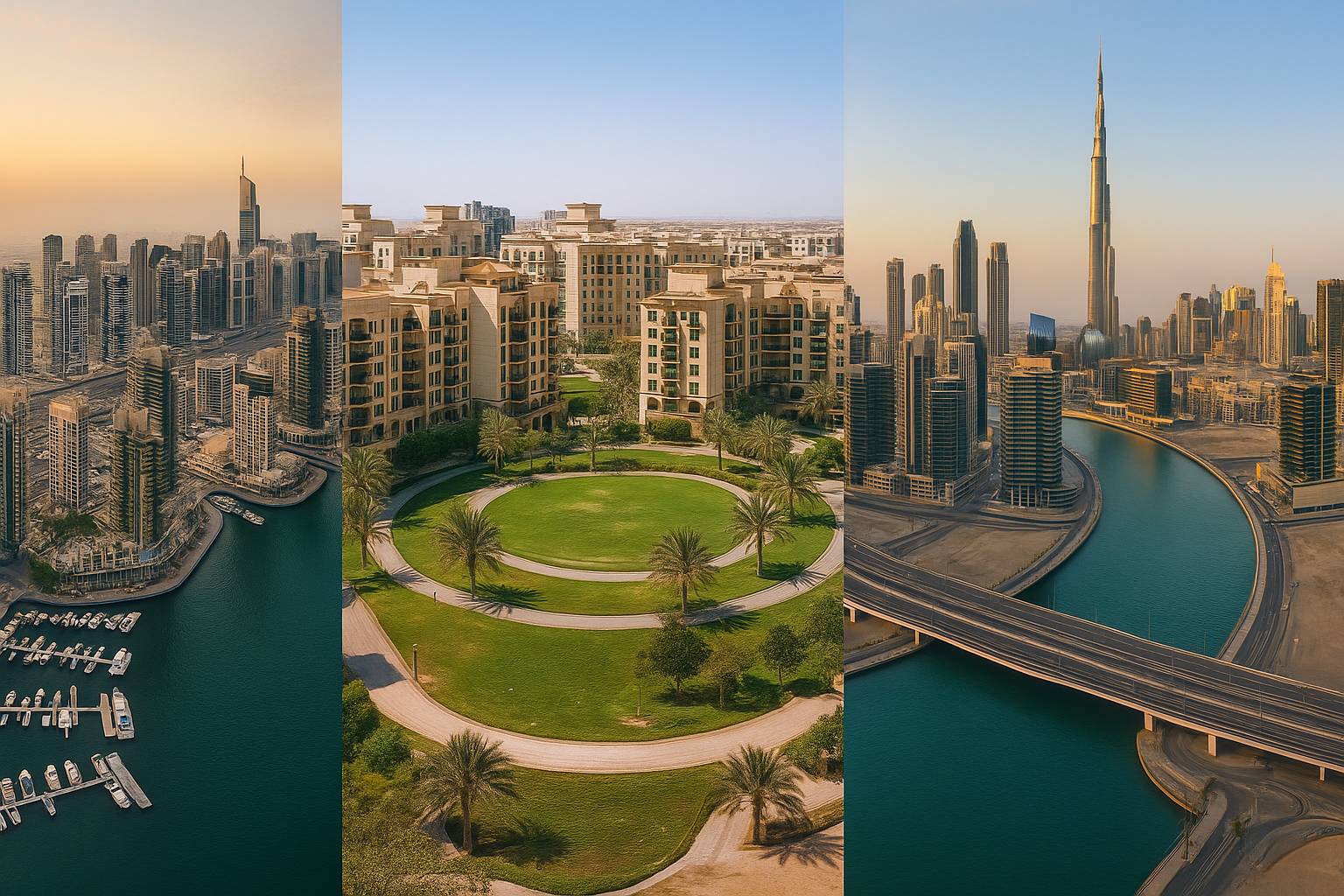


Dubai’s official statistics and online calculators give you tidy averages. But expat life here really depends on your choices—where you live, if you drive or take taxis, how often you go out for brunch, and whether you have kids. This uses the latest local data to break down the cost of living in Dubai and reveals what those calculators miss.
The “Single” Life – Survival vs. Thriving
The Rent Trap – JLT vs. Marina
Housing remains the single most significant expense. Average rents differ widely even within the same area. According to recent studies, a studio in Dubai Marina averages AED 69,716 a year, while the same size in Jumeirah Lake Towers (JLT) averages AED 57,726.
A one-bedroom apartment averages AED 95,420 per year in the Marina, compared to AED 81,965 in JLT. That’s a difference of about AED 10,000 just to live across a pedestrian bridge, showing how your choices can impact your budget.
Rent contracts also include some hidden costs:
- Security deposit: typically 5% of annual rent (10% if the property is furnished), refundable upon moving out.
- Agency commission: property agents charge ≈5 % of the annual rent, paid upfront.
- Housing fee: Dubai Municipality levies a 5 % housing fee (added to your DEWA bill) calculated on your annual rent.
- Chiller fees: Many high-rise buildings use district cooling, so residents pay separate “chiller” charges on top of their electricity bills.
The Social Tax – Taxis, Ride‑sharing and Fitness
Dubai’s heat and limited public transport make taxis or ride‑sharing essential. As of early 2025, Dubai Taxi Corporation charges a base fare of 5 AED (day) and 5.5 AED (night), plus approximately 2.9 AED per kilometre, with a minimum fare of around 12 AED.
Private ride-hailing (Uber or Careem) starts at about 15-19 AED, with per-kilometre rates around 2.35 AED. If you commute daily from JLT to Downtown or go out often, these costs can add up quickly.
Fitness is another cost to consider. GymNation, a budget-friendly chain that has shaken up Dubai’s pricey fitness scene, offers memberships starting at AED 199 per month for core, AED 259 for plus, and AED 499 for signature.
Before GymNation, gym memberships in Dubai often cost around AED 600 per month. Another option is ClassPass, which lets you use credits at boutique studios. Packages start at US$19 per month for eight credits and go up to US$79 for 38 credits (about AED 70–290, depending on the package and local prices). Some classes, like CrossFit or hot yoga, may use up several credits each.
Real‑Life Example – Meet Sarah (Income: AED 15,000/month)
Sarah works in marketing at a mid-level position. Here’s how she spends her salary when she chooses a middle-of-the-road lifestyle:
| Rent (1‑bed in JLT) | AED 7,000 | Annual rent ~AED 81,965 divided monthly, plus 5 % housing fee added to DEWA. |
| Utilities (DEWA + chiller) | AED 700–1,000 | Electricity & water; includes 5 % housing fee and district‑cooling charges. |
| Transport (taxis/Uber) | AED 1,200 | Combination of Metro, taxis and ride‑sharing for work and social outings (20 trips at 60 AED each). |
| Groceries & household | AED 1,500 | Milk (6.5–8.5 AED/L), bread (5–7 AED), eggs (10 AED/dozen) etc. |
| Dining & brunches | AED 1,500 | Casual meals for two (100–250 AED) and occasional Friday brunch (200–300 AED per person). |
| Fitness | AED 259 | GymNation “Plus” membership. |
| Leisure/entertainment | AED 800 | Movies (45–60 AED), desert tours, occasional concerts. |
| Savings/other | AED 2,200 | Insurance, unexpected costs, travel fund. |
The takeaway: Sarah lives comfortably, but not lavishly. If she moved to the Marina, which costs about AED 10,000 more in rent each year, or switched from taxis to leasing a car, her expenses would rise fast.
The “Family” Burden – Hidden Fees Multiply
Schooling Isn’t Just Tuition
Education is often the most significant family expense. Here is a list annual tuition ranges:
- Indian curriculum: AED 12,000–64,000 per year.
- British curriculum: AED 15,000–77,000.
- American curriculum: AED 12,000–87,000.
- Public schools (for expats): AED 6,000–12,000.
Tuition isn’t the only expense. For example, the School of Modern Skills charges a non-refundable seat reservation fee equal to 10% of the annual tuition when you enrol or re-enrol. School bus transport costs AED 4,200 per year for one-way trips or AED 5,600 for round-trips in Dubai. Uniforms, books, and yearly activities add even more to the total.
The Help – Nanny/Maid Visa Costs
In 2025, families who need full-time domestic help have to budget for more than just salaries. Here’s what the new Work Bundle process costs:
- Visa application & processing fee: AED 5,000–6,000.
- Medical fitness test: AED 500–700.
- Health insurance: AED 700–1,500 annually.
- Emirates ID & visa stamping: AED 500–1,000.
- Refundable deposit: AED 2,000.
So, total sponsorship costs range from AED 8,500 to 17,000, not including the maid’s monthly salary. Only households with a monthly income of at least AED 25,000 are legally allowed to sponsor a maid.
Car vs. Taxi – Why Families Buy Cars
For single professionals, taxis and ride-sharing can be affordable. But for families who need to run errands, make school runs, and take weekend trips, owning a car is usually cheaper than taking taxis all the time. Here’s an example using a 2018 Toyota Corolla, which costs AED 71,900 to buy:
- 20 % down payment: AED 14,180 (one‑time)
- Monthly instalment (5‑year loan): AED 980
- Comprehensive insurance: AED 3,000–4,000 per year
- Registration & inspection: AED 1,000 annually
- Maintenance & servicing: AED 1,000 annually
- Salik registration: AED 100 (online), plus Salik & fuel costs estimated at AED 4,000–5,000 per year
- Yearly total (excluding down payment): AED 20,800
Starting January 2025, Dubai’s Salik toll gates will use dynamic pricing. Tolls during rush hours (6–10 AM and 4–8 PM) will be AED 6, while off-peak hours remain AED 4. Tolls are free from 1 AM to 6 AM. Families who drive through several gates every day can easily spend AED 300 to 400 per month on Salik alone.
The “Silent” Budget Killers – The AI‑Beater Section
DEWA Housing Fee & Utilities
Dubai Municipality charges a housing fee equivalent to 5% of your annual rent, collected monthly on your DEWA (Dubai Electricity & Water Authority) bill. For a one‑bedroom apartment renting at 90k AED/year, the housing fee adds 375 AED per month.
Electricity rates depend on how much you use, ranging from 0.23 to 0.38 AED per kWh. Water costs about 0.003 AED per gallon. District cooling (chiller) charges are billed separately, and many high-rise buildings charge a fixed fee plus usage. Depending on your property, you can expect to pay several hundred dirhams per month.
Agency Commission & Security Deposits
- Agency fee: typically 5% of annual rent, paid once at lease signing.
- Security deposit: 5% of annual rent for unfurnished units and 10% for furnished units.
These upfront costs can add up to AED 10,000 to 15,000 for a modest apartment, tying up cash that most calculators don’t mention.
Visa Renewal & Medical Tests
For residents renewing their own visas, medical tests are mandatory. An independent guide lists Dubai Health Authority (DHA) medical fitness fees as follows:
- Regular service (results within five working days): AED 322.5.
- 48‑hour service: AED 432.5
- 24‑hour service: AED 532.5
- 4‑hour VIP service: AED 752.5
For housemaid visas, the fees are a bit higher: regular service costs AED 372.5, and VIP (4 hours) costs AED 802.5. Vaccination for Hepatitis B adds AED 50. Picking express services can triple your total cost.
Cost of Living in Dubai: The Minimum vs. the Comfortable Number
Dubai has options for every budget, from affordable living to luxury. A single person can get by on AED 7,000 to 8,000 per month by sharing a place in the outer areas, using public transport, skipping brunches, and choosing GymNation over boutique studios.
However, most expats are attracted to Dubai’s convenience and social life, so a more comfortable budget is closer to AED 12,000 to 15,000 per month for singles and AED 25,000 to 40,000 per month for families.
Online calculators rarely show the details, like rent differences between neighbourhoods, school seat-reservation fees, maid-visa deposits, Salik toll increases, or the temptation of Friday brunches. When planning your move, consider both the costs you’ll need and the lifestyle extras that can make Dubai an exciting, though more expensive, place to live.