



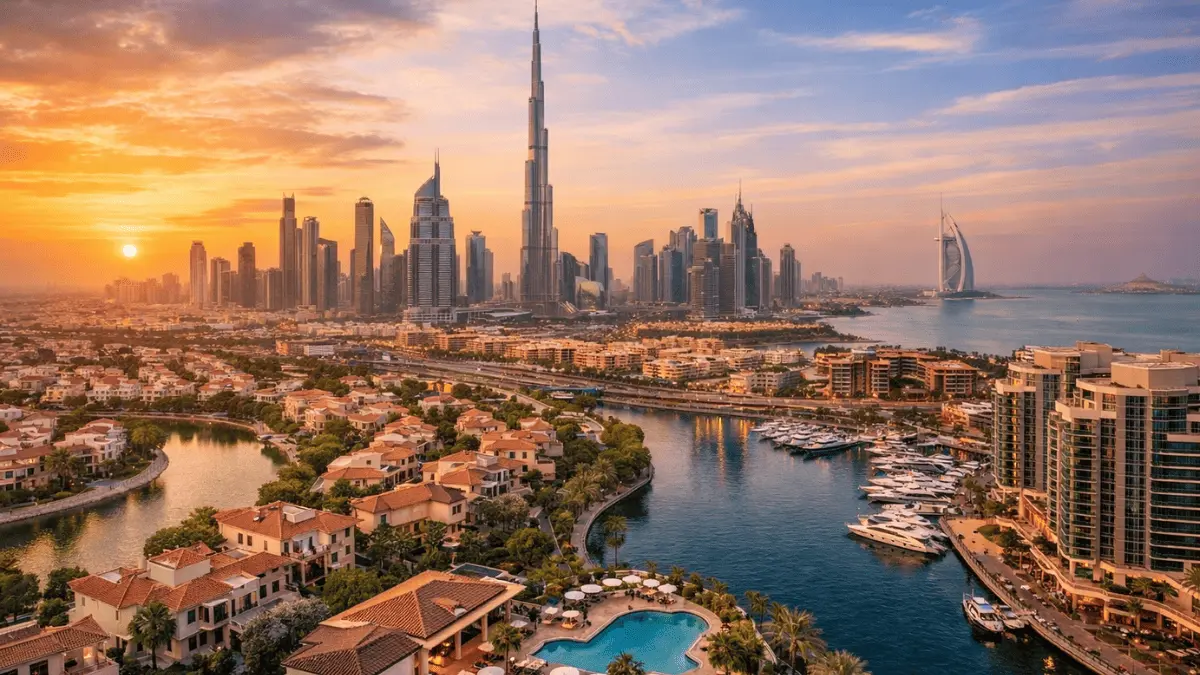




Dubai real estate refers to the property market in the Emirate of Dubai, overseen by the Dubai Land Department (DLD) and the Real Estate Regulatory Agency (RERA). Foreign nationals can buy freehold property in 23 designated zones, such as Dubai Marina, Downtown Dubai, Palm Jumeirah, Jumeirah Village Circle (JVC), Dubai Hills Estate, and Business Bay.
UAE and GCC citizens can purchase property anywhere in Dubai. The market is divided into off-plan sales (buying under-construction property directly from developers) and secondary sales (buying ready property from current owners), with off-plan transactions making up about 60% of total volume in 2025.
What is Dubai real estate, and how does the market work?
Dubai real estate is among the most active and accessible property markets for foreigners worldwide. In 2024, total transaction volume hit AED 761 billion across 226,000 transactions, setting a new record for Dubai. The market operates under Federal Law No. 7 of 2006 (the Land Registration Law), is regulated by the Dubai Land Department, and compliance and dispute resolution are handled by the Real Estate Regulatory Agency.
The market mainly features three property types: apartments, which make up most transactions and are found in high-rise areas like Dubai Marina, JLT, Downtown, and Business Bay; villas and townhouses, located in low-rise communities such as Arabian Ranches, Dubai Hills Estate, Damac Hills, JVC, and Tilal Al Ghaf; and land plots, which are usually bought by developers or sometimes by very wealthy individuals. Office and retail commercial properties are available but make up a much smaller part of the market.
There are three types of property ownership in Dubai. Freehold ownership gives permanent rights to the land and building and is available to any nationality in designated freehold zones. Leasehold ownership allows long-term use, usually for 30 to 99 years, but does not include ownership of the land. GCC-only ownership restricts certain non-freehold areas to UAE and Gulf Cooperation Council citizens. For most expat buyers, freehold is the main option, and the 23 freehold zones cover most of Dubai’s best investment properties.
Who can buy property in Dubai?
Any foreign national can buy freehold property in Dubai. There are no restrictions based on nationality, no minimum residency requirement, and you do not need a UAE visa to make a purchase. A non-resident can visit Dubai on a tourist visa, buy property, and leave with the title deed within a week. This openness is a key reason Dubai attracts international investors.
There are three main types of buyers to consider. Resident expats living in Dubai with a valid residence visa have the easiest process and best mortgage terms, usually up to 80% loan-to-value for first properties under AED 5 million. Non-resident foreigners can buy with cash or through non-resident mortgages, but fewer banks offer these and loan-to-value ratios are limited to 50–65%.
Companies, such as UAE-registered LLCs or free zone entities, can also own property, but this adds extra costs and complexity, making it worthwhile mainly for institutional investors or those planning several purchases.
A special incentive is the UAE Golden Visa for property investors. If you buy property worth AED 2 million or more, either as a single purchase or combined, you qualify for a 10-year renewable residence visa for yourself, your spouse, and your dependent children.
The visa does not require you to live in the UAE, making it a valuable option for international buyers who want residency flexibility. The Golden Visa program is managed by the General Directorate of Residency and Foreigners Affairs (GDRFA), and more details are available in our guide on the property route to the Golden Visa.
Should you buy or rent property in Dubai?
Buying property in Dubai makes sense if you plan to stay for four years or more, want UAE residency through the Golden Visa, or have extra capital looking for a 6–9% gross rental yield. Renting is better if you plan to stay less than three years, are unsure about living in Dubai, or prefer flexibility without paying transaction costs.
For most expats, buying becomes cheaper than renting after about 4–5 years. If you stay less than that, transaction costs like the 4% DLD fee, 2% agent commission, and other mortgage and registration fees (totaling 7–8% of the purchase price) make renting more cost-effective. If you stay longer, you start building equity instead of paying rent to a landlord.
The decision matrix below outlines the most common scenarios. Use it as a starting point, not a final answer, since each buyer’s situation includes factors the table may not cover, such as career stability, family needs, or other investment options.
| Your situation | Buy? | Why |
| Newly arrived expat, 1–2 year contract, unsure about staying | Rent | Transaction costs exceed expected stay’s rent differential |
| Stable employment, 4+ year horizon, family relocating | Buy | Equity build-up exceeds rent over horizon |
| Cash investor, no UAE residency | Buy | Gross yields of 6–9% + Golden Visa at AED 2M+ |
| Want UAE residency for optionality | Buy | AED 2M property = 10-year Golden Visa |
| High income but inheritance/equity uncertain | Rent | Avoid forced sale risk |
| Already own property abroad, want diversification | Buy | Dubai is uncorrelated with Western property cycles |
For a deeper breakdown of the cumulative cost math, see our dedicated guide: Renting vs Buying in Dubai 2026 — The Honest Math.
How is the Dubai property market performing in 2026?
In 2026, the Dubai property market is stabilizing after the post-pandemic boom from 2022 to 2024. Year-on-year price growth has slowed from the 20–30% highs of 2023 to a more sustainable 5–10%. Dubai Land Department’s H2 2025 data shows average residential prices at AED 1,520 per square foot for apartments and AED 1,470 per square foot for villas.
The strongest growth is seen in established prime areas like Palm Jumeirah, Downtown, and Dubai Marina, as well as newer villa communities such as Tilal Al Ghaf, Dubai Hills Estate, and Damac Hills 2.
Three major changes are shaping the market this year. Off-plan transactions now account for about 60% of total volume, up from 45% before the pandemic, thanks to attractive developer payment plans such as 1% monthly payments, 80/20 splits, and post-handover plans lasting 3–5 years.
The secondary market is focusing on prime locations, as buyers prefer ready apartments in established communities over off-plan units in newer areas. This has reduced the secondary discount and increased the off-plan discount. Foreign cash buyers now account for over 40% of purchases, with Indian, Russian, British, and Pakistani nationals leading the way, according to DLD nationality reports.
Since 2024, three regulatory changes have impacted buyers in 2026. The Mollak system requires transparency into service charges for all jointly owned properties, so buyers can check a building’s service-charge history before buying. RERA’s updated escrow rules require developers to deposit progress payments into escrow accounts at each construction milestone, greatly reducing the risk of off-plan delays compared to before 2020.
The UAE Corporate Tax, introduced in 2023, affects property-investing companies, but personal investment income remains untaxed for individuals.
Looking forward, Dubai-focused analysts like Knight Frank, JLL, and CBRE Middle East expect annual price growth of 5–8% in prime areas through 2027. Some master-planned communities may perform even better as infrastructure projects finish. The Expo 2020 site, now called Expo City Dubai, is developing as a residential and commercial hub. The new Etihad Rail link to Abu Dhabi, starting in 2026–2027, is likely to boost property values in Dubai South and Jebel Ali.
How do you actually buy property in Dubai? (The 7-step process)
Buying property in Dubai involves a standard seven-step process set by the Dubai Land Department, starting with the initial offer and ending with title deed registration. Cash purchases usually take 30–60 days, while mortgage-financed purchases take 60–90 days. Each step follows a set order and requires specific documents and timing.
Step 1: Mortgage pre-approval (if financing)
If you plan to use a mortgage, pre-approval is the first step. UAE banks provide pre-approvals that secure your loan amount for 60 days, allowing you to make offers confidently. You will need documents like a salary certificate or six months of bank statements, Emirates ID, passport copy, and three months of credit card and loan statements. Pre-approval usually takes 5–10 working days.
Step 2: Property search and offer
You can search for property in Dubai using three main channels: major online portals like Bayut, Property Finder, and Dubizzle; direct contact with a brokerage; or developer sales offices for off-plan properties. RERA requires all listing agents to have a valid Broker Card and for listings to show a permit number.
Listings without these are illegal and should be avoided. After you find a property, your agent submits a written offer. Price negotiations in secondary sales usually result in a final price 3–7% below the initial asking price, while off-plan launches have less room for negotiation.
Step 3: Signing the Memorandum of Understanding (MoU / Form F)
The MoU, which is DLD’s standard Form F, is the binding sales agreement between buyer and seller. It includes the purchase price, deposit amount (usually 10% of the price, paid by manager’s cheque), and the timeline for transfer. Both parties sign at the brokerage office or at the Dubai Land Department. After signing, the buyer usually has 30–45 days to complete the transfer. If the deadline is missed, the deposit may be forfeited.
Step 4: NOC (No Objection Certificate) from the developer
The developer issues an NOC confirming the seller has no outstanding service charges or mortgages registered against the unit. NOC fees vary by developer (AED 500-5,000), and processing takes 3–10 working days. For off-plan purchases, this step is replaced by the developer’s direct sales process and Oqood registration.
Step 5: Mortgage finalisation (if financing)
With the MoU signed and the NOC issued, the bank conducts the property valuation (typically a fee of AED 2,500–3,500, paid by the buyer) and finalises the loan. The bank issues a final offer letter, which the buyer signs along with a mortgage agreement. The mortgage is registered with DLD at the transfer appointment.
Step 6: Transfer at the Dubai Land Department
The transfer takes place at a DLD Trustee Office, which are found throughout Dubai, including Manazel Al Khor, Wasl, and Damac Trustee. Both parties or their representatives attend, all fees are paid by manager’s cheque, and DLD completes the ownership transfer on the same day. You will need the buyer’s Emirates ID and passport, the seller’s Emirates ID and passport, the original title deed, NOC, MoU, and mortgage documents if needed.
Step 7: Title deed issuance and handover
DLD issues the new title deed in the buyer’s name within 24 hours of the transfer appointment, downloadable from the Dubai REST app. Keys, access cards, and utility account transfers happen the same day or within a week. Ejari registration (the tenancy contract registration for any future rental income) and DEWA setup are the last post-purchase formalities.
For an expanded walkthrough of every step with exact documents, fees, and common pitfalls, see The Dubai Property Buying Process — 7 Steps From Offer to Title Deed.
Should you buy off-plan or ready property in Dubai?
Off-plan property in Dubai is bought directly from the developer before or during construction, with payments spread out over the construction period and sometimes after handover. Ready property is bought from a current owner on the secondary market, and the full price is paid at the time of transfer. Choosing between these options is a major decision for buyers, and the best choice depends on your available funds, risk tolerance, and timing.
Off-plan properties are popular because of flexible payment plans. For example, an off-plan unit priced at AED 1.5 million may require AED 150,000 (10%) at booking, with the rest paid over 3–5 years through milestone payments and a post-handover plan. This allows investors to control a AED 1.5M asset with only AED 150K upfront, benefiting from capital appreciation during construction (usually 15–25% over three years) before paying most of the price.
The downside is construction risk, including possible delays, developer bankruptcy (rare since RERA escrow reforms), and holding an unfinished asset for years.
Ready property eliminates construction risk and provides immediate cash flow. A ready apartment priced at AED 1.5M can earn rental income from the start, usually AED 100,000–135,000 per year at a 6.5–9% gross yield. It can be mortgaged at good rates and comes with proven rental history and service charge records. The downside is paying the full price upfront, missing out on off-plan appreciation, and less marketing hype to boost secondary value.
| Factor | Off-plan | Ready (secondary) |
| Upfront capital | 10–20% deposit | 100% (cash) or 20–25% + mortgage |
| Income from day one | No (3–5 years until rental) | Yes (immediate) |
| Capital appreciation potential | 15–30% over construction | 5–10% annually in established areas |
| Construction / delivery risk | Yes — mitigated by RERA escrow | None |
| Service charge transparency | Estimated, not historical | Documented via Mollak |
| Resale liquidity | Limited until handover | Liquid market |
| Best for | Investors with appreciation thesis | Income investors and end-users |
The off-plan ecosystem in Dubai has its own set of deep rules — payment plan types, developer track records, RERA escrow mechanics, Oqood registration — covered in detail in our dedicated guide, Dubai Off-Plan Property — The 2026 Buyer’s Complete Playbook.
How much does it cost to buy property in Dubai?
The total cost to buy property in Dubai is about 7–8% of the purchase price for cash buyers and 8–10% for those using a mortgage. This includes DLD registration, agent commission, NOC, mortgage registration, and bank valuation fees. For a AED 1.5 million property, expect to pay AED 105,000–150,000 in fees in addition to the property price.
| Fee | Amount | Paid to | When |
| DLD transfer fee | 4% of purchase price | Dubai Land Department | At transfer |
| Agent commission | 2% + 5% VAT | Brokerage | At transfer |
| Trustee / registration fee | AED 4,000 (under AED 500k: AED 2,000) | DLD Trustee Office | At transfer |
| Title deed issuance | AED 580 | DLD | At transfer |
| NOC fee | AED 500–5,000 | Developer | Before transfer |
| Mortgage registration fee | 0.25% of mortgage + AED 290 | DLD | At transfer |
| Bank valuation fee | AED 2,500–3,500 | Mortgage bank | During mortgage processing |
| Bank arrangement fee | 0.5–1% of loan | Mortgage bank | At loan signing |
| Conveyancing (optional) | AED 3,000–10,000 | Lawyer / conveyancer | During process |
First-time buyers often overlook three costs. Service charges are annual maintenance fees for shared facilities, usually AED 12–25 per square foot per year for apartments and AED 3–7 per square foot for villas. For a 1,000 sqft apartment, this adds up to AED 12,000–25,000 per year, on top of mortgage and utilities.
DEWA security deposits are required when setting up utilities (AED 2,000 for apartments, AED 4,000 for villas). Chiller charges for district cooling can be AED 5,000–20,000 per year, depending on the building and usage. “Chiller-free” buildings include this in service charges, while others bill separately.
How do mortgages work in Dubai?
Major UAE banks like Emirates NBD, Mashreq, ADCB, FAB, HSBC, and Standard Chartered issue mortgages in Dubai, following regulations from the Central Bank of the UAE. For UAE residents buying their first home valued at AED 5 million or less, the maximum loan-to-value (LTV) ratio is 80%, so a minimum 20% cash deposit is needed. For properties over AED 5 million, second homes, or non-residents, LTV limits are lower, usually 60–65% for second homes and 50–65% for non-residents.
In 2026, mortgage rates range from about 3.99% to 5.75% for fixed-rate products (fixed for 1–5 years) and from EIBOR + 1.0% to EIBOR + 2.5% for variable products. The maximum mortgage term is 25 years, and the oldest you can be at loan completion is 65 for employees or 70 for self-employed and business owners.
To qualify, you need a minimum monthly income of AED 15,000 if salaried or AED 25,000 if self-employed, and your debt-burden ratio (DBR) must be below 50%. This means your total monthly debt, including the new mortgage, cannot be more than half your gross monthly income.
There are three main types of borrowers to note. Salaried expats have the easiest process and get the best rates. Self-employed business owners can get mortgages but usually pay 0.5–1% higher rates and must provide two years of audited financials. Non-resident buyers without a UAE visa can get mortgages from fewer banks, at higher rates (usually 5.5–7%), with lower LTVs (50–65%), and shorter terms (often up to 15 years).
We compare every major UAE mortgage product and bank in detail, with monthly rate updates, in our Dubai Mortgage Guide 2026. For broker recommendations, see Best Mortgage Brokers in Dubai.
What about renting in Dubai?
Renting in Dubai is governed by RERA’s tenancy law, and rental contracts are registered through Ejari, which means “my rent” in Arabic and is the official registration platform. Most Dubai rental contracts are for one year, paid in 1, 2, 4, or 12 cheques, depending on what the landlord allows. More cheques offer more flexibility but can mean a slightly higher annual rent.
Security deposits are 5% of annual rent for unfurnished properties and 10% for furnished ones, refundable at the end of the lease minus any documented damages.
Three regulations protect tenants in Dubai, which many newcomers may not know. The RERA Rental Index sets the maximum percentage a landlord can raise rent at renewal, usually 0%, 5%, 10%, 15%, or 20%, depending on how much the current rent is below market rate. Landlords must give 90 days’ written notice for any rent increase and can only evict tenants for specific legal reasons. The Rental Disputes Centre at DLD offers quick, affordable resolution of landlord-tenant disputes, with most cases settled within 30 days.
Renting is its own deep topic — Ejari registration, rental cheque mechanics, security deposit disputes, RERA index calculations, tenant rights — covered in our full Renting in Dubai cluster.
What are the best neighbourhoods in Dubai to live or invest in?
Dubai’s residential neighbourhoods are generally grouped into three tiers based on price and prestige. Prime areas include Downtown, Palm Jumeirah, Emirates Hills, and Dubai Hills Estate. Upper-middle areas are Dubai Marina, Business Bay, JLT, Arabian Ranches, and Damac Hills. Value areas include JVC, JVT, Mirdif, Town Square, and Tilal Al Ghaf. The best neighbourhood for you depends on whether you’re a single professional, a family with children, a remote worker, or an investor.
Dubai Marina
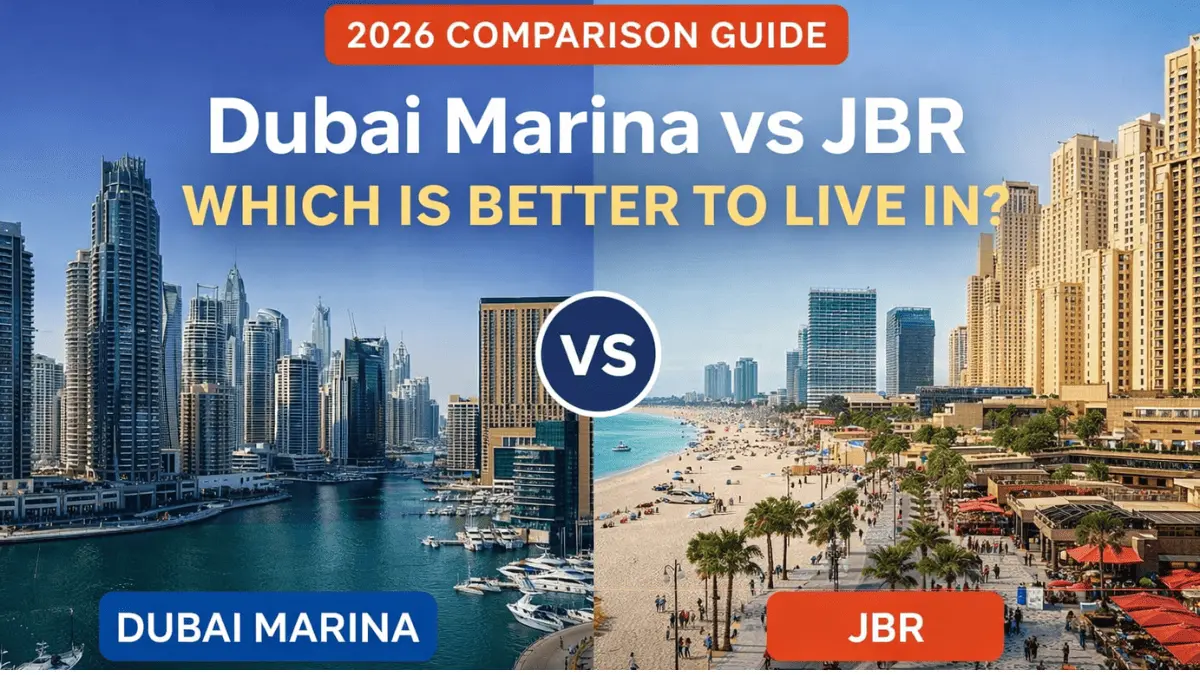
Dubai Marina is a 3.5km master-planned waterfront community developed by Emaar between 2003 and 2014, containing 200+ residential towers, a 7km promenade, and direct connection to JBR and Bluewaters Island. The community is favoured by young professionals and couples for its walkability, dining density, and metro access. Gross rental yields range from 6.5% to 8%, with consistent capital appreciation tracking the broader Dubai market. Full breakdown in our Dubai Marina Living Guide and Dubai Marina Investment Guide.
Downtown Dubai
Downtown Dubai is the most central neighbourhood, anchored by the Burj Khalifa, the Dubai Mall, and the Dubai Opera. Properties here command premium prices (AED 2,200–4,500 per square foot) with corresponding premium rents and stable 6–7% yields. Best for international investors prioritising prestige and an instantly recognisable address, less ideal for value-focused yields.
Palm Jumeirah
Palm Jumeirah is the man-made island development by Nakheel, completed in 2006 and now a mature luxury community with both apartment towers along the trunk and signature villas on the fronds. Apartment yields run 5.5–7%, villa yields 4–6% — Palm prioritises capital and lifestyle over yield. Our Palm Jumeirah Living Guide covers the distinction between the apartment and villa lifestyle in detail.
Jumeirah Village Circle (JVC)
JVC is a freehold community developed by Nakheel between 2005 and the present, with a circular master plan divided into numbered districts. JVC has been Dubai’s strongest value-yield play for several years, with gross yields commonly running 8–10% and entry prices accessible (1BR apartments starting AED 600,000). Trade-off: significant ongoing construction noise in some districts. Our JVC Living Guide covers which buildings to favour and which districts to avoid.
Dubai Hills Estate
Dubai Hills is a master-planned community by Emaar (Mohammed bin Rashid City), built around an 18-hole championship golf course with apartments, townhouses, and large villas across the development. Strong family appeal with schools (GEMS Wellington Academy, Dubai Hills International School), Dubai Hills Mall, and parkland. Yields are mid-range (5.5–7%), but capital appreciation has consistently outpaced city averages since 2020.
Other neighbourhoods worth shortlisting
Business Bay (Downtown’s neighbour, lower prices for similar metro access), JLT (Marina’s neighbour, often 20% cheaper for comparable views), Arabian Ranches (mature family villa community), Damac Hills (golf-fronted villas at value prices), Mirdif (older non-freehold area now permitting freehold purchase in select developments), Town Square (Nshama’s value-tier master plan), and Tilal Al Ghaf (Majid Al Futtaim’s lagoon-focused community). Each has its own dedicated living guide in our neighbourhoods cluster.
What returns can you expect from Dubai property?
Dubai property offers some of the highest gross rental yields among global investment cities. Citywide average gross yields are 6.5–7.5% across all property types, while certain areas like JVC, International City, and Discovery Gardens yield 8–10%. Capital appreciation in established freehold areas has averaged 6–9% per year over the past three years, but yearly figures can vary a lot depending on the community and property type.
The comparison below shows gross rental yields by neighbourhood as of Q1 2026, derived from RERA’s published rental data and current asking prices on the major portals. Net yields are typically 1.5–2.0 percentage points lower than gross after service charges, management fees, and vacancy.
| Neighbourhood | Avg. gross yield | Avg. price/sqft (AED) | Typical 1BR rent (AED) |
| JVC | 8.5–10% | 950–1,200 | 55,000–75,000 |
| International City | 9–11% | 650–800 | 32,000–42,000 |
| Dubai Marina | 6.5–8% | 1,650–2,200 | 90,000–125,000 |
| Business Bay | 7–8.5% | 1,500–1,950 | 80,000–115,000 |
| Downtown Dubai | 5.5–7% | 2,200–4,500 | 110,000–180,000 |
| Palm Jumeirah | 5–6.5% | 2,800–5,500 | 140,000–220,000 |
| Dubai Hills Estate | 5.5–7% | 1,800–2,400 | 95,000–135,000 |
| JLT | 7–8.5% | 1,250–1,650 | 70,000–95,000 |
A fact that surprises many foreign investors is that Dubai property income is not taxed as personal income for individuals. The UAE does not have income tax on personal earnings, capital gains tax on residential property owned by individuals, or inheritance tax on property. The corporate tax introduced in 2023 applies only to property held by companies with profits exceeding AED 375,000.
What are the most common mistakes Dubai property buyers make?
Five common mistakes cause most regret among Dubai property buyers, and all can be avoided with proper research. We see these issues regularly with first-time buyers. The list below is ranked by financial impact, from biggest to smallest.
Not checking the service-charge audit before buying. Some buildings have service charges three times higher than the area average, which can reduce net yield by 2–3 percentage points. Always review the Mollak history before signing, as RERA requires this information to be available to buyers.
Buying off-plan from a developer without a proven track record. Top developers like Emaar, Sobha, Nakheel, Meraas, and Dubai Properties have many years of experience. Smaller developers can vary in reliability, so check their last three project deliveries before investing.
Not fully considering chiller charges and other utility costs. The terms “chiller-included” and “chiller-free” can mean different things to different sellers, so always confirm what is included and check the unit’s past bills before buying.
Buying off-plan when you need liquidity. Off-plan units are hard to resell before handover, and developer transfer fees on resale can be 3–7% of the purchase price. If you may need to sell before completion, choose ready property instead.
Picking a neighborhood that doesn’t fit your lifestyle. Dubai Marina is lively but noisy and has heavy traffic, while Arabian Ranches is peaceful but requires a car. Spend time in any neighborhood at different times before buying, as what seems appealing during a Sunday afternoon viewing may be difficult during weekday morning traffic.
Frequently asked questions
Can foreigners actually own property in Dubai outright?
Yes — foreigners of any nationality can own freehold property outright in 23 designated freehold zones in Dubai, with full ownership rights including the right to sell, lease, inherit, or use as collateral. The title deed is issued in the buyer’s personal name by the Dubai Land Department. There is no requirement to hold a UAE visa or residency at the time of purchase.
How much money do I need to buy property in Dubai?
For a typical AED 1.5 million property, expect to need approximately AED 405,000–525,000 in liquid cash upfront if mortgaging (20% deposit of AED 300,000 plus 7–8% in fees totaling AED 105,000–120,000, plus AED 0–105,000 buffer for early-stage costs). For cash purchases, the full AED 1.5M plus AED 105,000–120,000 in fees. Off-plan can be entered with as little as AED 150,000–225,000 upfront on a AED 1.5M unit, with payments staggered across the construction period.
Is Dubai real estate a good investment in 2026?
Dubai real estate provides some of the highest gross rental yields among global investment cities, ranging from 6.5–10% depending on the neighbourhood. There is no personal income tax on rental income for individuals, and buying property worth over AED 2 million offers a residency pathway through the Golden Visa. The market is cyclical, and prices have increased by 50–70% in many areas since 2021. Buyers in 2026 should not expect recent appreciation rates to continue. A steady 5–8% appreciation and a 6–8% rental yield are realistic expectations for prime areas, rather than the 20%+ gains seen in 2022–2023.
Do I need to be in Dubai to buy property?
No, you do not need to be in Dubai to buy property. You can purchase remotely by granting a power of attorney (POA) to a UAE-based representative, such as your lawyer or property consultant. Many international buyers complete the process without visiting Dubai, using video viewings and remote document signing. The POA must be notarised in your home country, attested by the UAE embassy there, then translated and attested in Dubai.
What is the Golden Visa, and how does property qualify me for it?
The UAE Golden Visa is a 10-year renewable residence visa granted to individuals who meet specific qualifying criteria, one of which is property investment of AED 2 million or more. The visa covers the property owner, their spouse, dependent children, and (in many cases) parents. Property can be either ready or off-plan (provided AED 2M has been paid), single property or multiple combined, financed or paid in cash (provided the mortgage is at least AED 2M down).
Can I get a mortgage as a non-resident foreigner?
Yes — several UAE banks (HSBC, Standard Chartered, Mashreq, Emirates NBD) offer mortgages to non-resident foreigners, with loan-to-value caps of 50–65% (depending on bank and property value), rates approximately 1–2 percentage points higher than resident rates, and tenures typically capped at 15–20 years. Documentation requirements are heavier than resident mortgages — expect to provide three to six months of bank statements, salary or income documentation, credit reports from your home country, and reference letters from your home bank.
What are the annual costs after I buy?
Annual costs for a typical AED 1.5M Dubai apartment include service charges (AED 12,000–25,000), DEWA utilities (AED 8,000–18,000 depending on AC use), chiller charges if not included in service charges (AED 5,000–15,000), home insurance (AED 1,500–3,000), and any mortgage interest. The total non-mortgage annual operating cost is usually AED 30,000–55,000, which is factored into yield calculations as the difference between gross and net yields.
What’s the difference between freehold and leasehold property in Dubai?
Freehold property in Dubai grants permanent, outright ownership of both the building and the land beneath it, with full inheritance and resale rights. Leasehold property grants long-term use rights (typically 30–99 years) without ownership of the underlying land, after which ownership reverts to the original landowner unless renewed. For foreign buyers, freehold is by far the more common and more attractive option, available in 23 designated zones covering most of Dubai’s investable communities.
Where to go from here
This guide is the entry point to the real estate decisions you’ll make in Dubai. The cluster pages below go into more detail on each specific path.
- If you’re deciding whether to buy or rent: Renting vs Buying in Dubai 2026 — The Honest Math
- If you’re leaning toward off-plan: Dubai Off-Plan Property — The 2026 Buyer’s Complete Playbook
- If you need a mortgage: Dubai Mortgage Guide 2026
- If you’re shortlisting neighbourhoods, browse our neighbourhood cluster, starting with the Dubai Marina Living Guide.
- If you’re a renter: Renting in Dubai — The Complete First-Timer’s Walkthrough
Have a specific question or need help finding the right property? Message us on WhatsApp — we work with two specialist brokerages (one off-plan-focused, one secondary-market-focused) and can connect you with the right team for your situation, at no cost to you.
Last reviewed: June 2026 by RaynaSean, Dubai-resident property writer with 6 years covering the UAE market.
Primary sources cited: Dubai Land Department (dubailand.gov.ae), Real Estate Regulatory Agency, Central Bank of UAE monthly statistics, Dubai Statistics Centre.
Disclaimer: This guide is for informational purposes, not financial advice. Property purchase decisions should be made in consultation with a licensed financial advisor and RERA-registered broker. The tax and visa rules cited are current as of the publication date and may change.
